
Article
Why Your Brand Needs a Multi-Model AI Visibility Strategy
For years, search engine optimization followed one simple rule: optimize for Google to win. That...

Mar 13, 20269 min Read
Continue Reading
What ChatGPT reads and what it cites aren’t always the same thing. In fact, ChatGPT reads far more sources than it includes as citations in its answers.
When ChatGPT searches the web, it displays a list of pages it searched or identified as sources. But not every page on that list earns a citation in the final answer. For businesses trying to improve their visibility in AI search, understanding that difference is important.
Using PAVE, our AI visibility intelligence engine, our GEO team analyzed 11,212 ChatGPT answers to 2,653 unbranded buying questions across 59 industries. We wanted to understand which pages ChatGPT reads, which ones it cites, and what those patterns mean for businesses.
Our biggest finding? 43% of the page reads we tracked didn’t result in a citation in the corresponding answer. We also uncovered interesting patterns in the types of content most likely to earn citations, and what businesses can do to improve their visibility.
When you ask ChatGPT a question, it will often search the web before answering. During that process, ChatGPT displays a list of websites and pages it searched. Then, in its final answer, it cites some of those pages, but not necessarily all of them.
Most AI visibility tracking tools measure citations in the final answer. But that only tells part of the story. A page could appear in ChatGPT’s search activity repeatedly without ever earning a citation.
For this study, we compared both lists across 11,212 ChatGPT answers collected by PAVE over three and a half weeks.
The study included 2,653 unbranded buying questions across 59 business fields. None of the questions mentioned a specific company. Instead, we asked the kinds of questions potential buyers might ask, such as what to look for in pharmacy software or who the leading commercial roofing contractors are.
This allowed us to examine how ChatGPT discovers and cites businesses without being prompted to consider a particular brand.
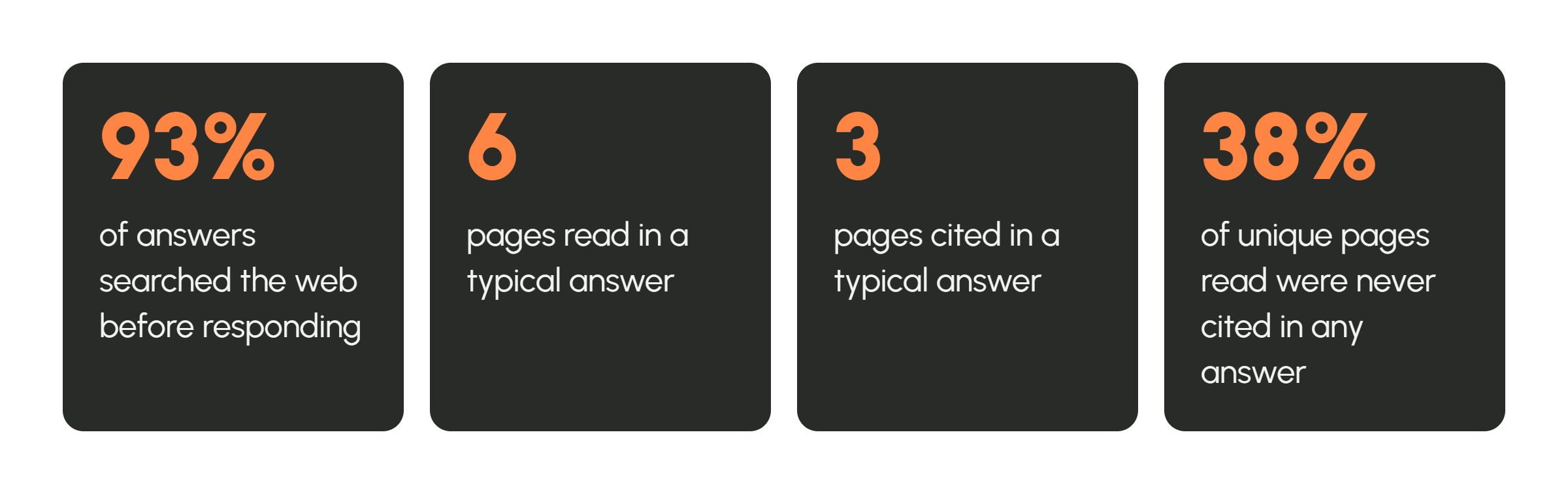
Before diving into the analysis, here’s a quick look at our key findings.
One of the most significant findings from our research is that 43% of the pages ChatGPT read were not cited in the corresponding answer.
If you’re only measuring citations, you’re missing a substantial portion of the pages ChatGPT encounters while answering questions.
That distinction matters for GEO. There’s a difference between a page ChatGPT never discovers and one it reads regularly but doesn’t cite. Both may have opportunities for improvement, but they likely require different approaches.
To measure this gap, we looked at every instance where ChatGPT read a page while answering one of our questions and checked whether that page was cited in the final response.
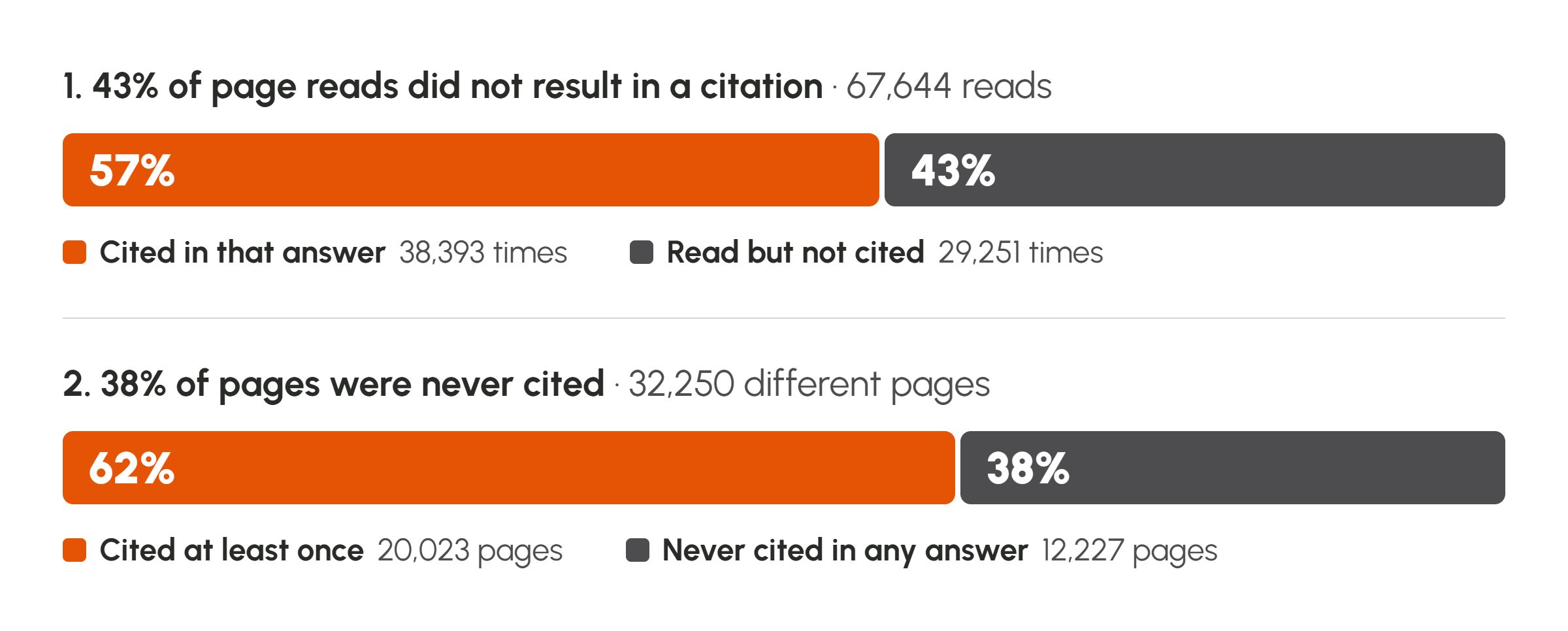
Across the study, we recorded 67,644 page reads. Of those:
We also looked at unique pages to understand how many were never cited at all.
ChatGPT read 32,250 different web pages during the study. Of those, 20,023 were cited at least once. The remaining 12,227 pages (38%) were never cited, even though some appeared in ChatGPT’s search activity multiple times.
This shows why tracking what ChatGPT reads alongside what it cites can provide a more complete picture of AI visibility.
Getting discovered by ChatGPT is only part of the challenge. Your content also needs to earn a place among the sources cited in its final answer.
Our research found that a typical ChatGPT answer reads five or six pages but cites only three.
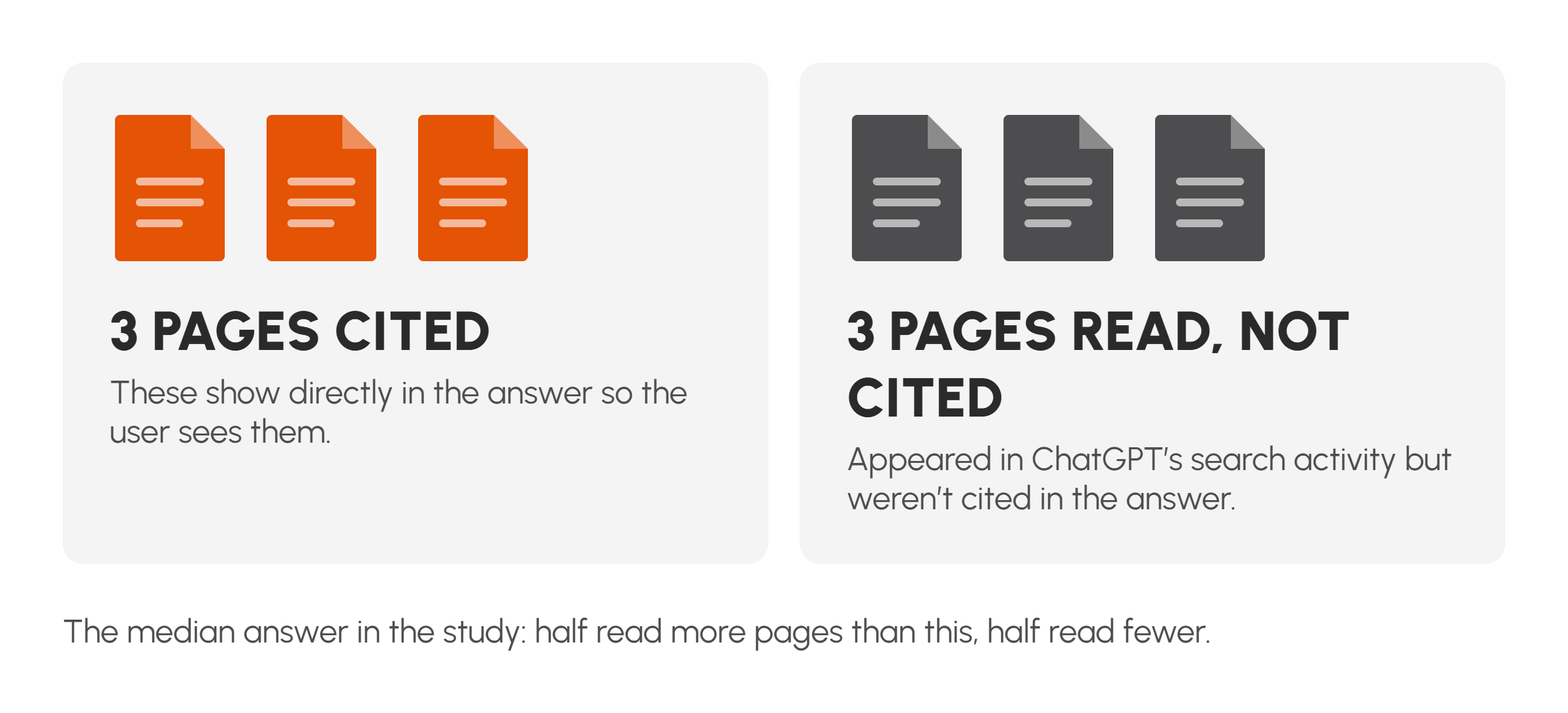
ChatGPT generally reads more sources than it credits:
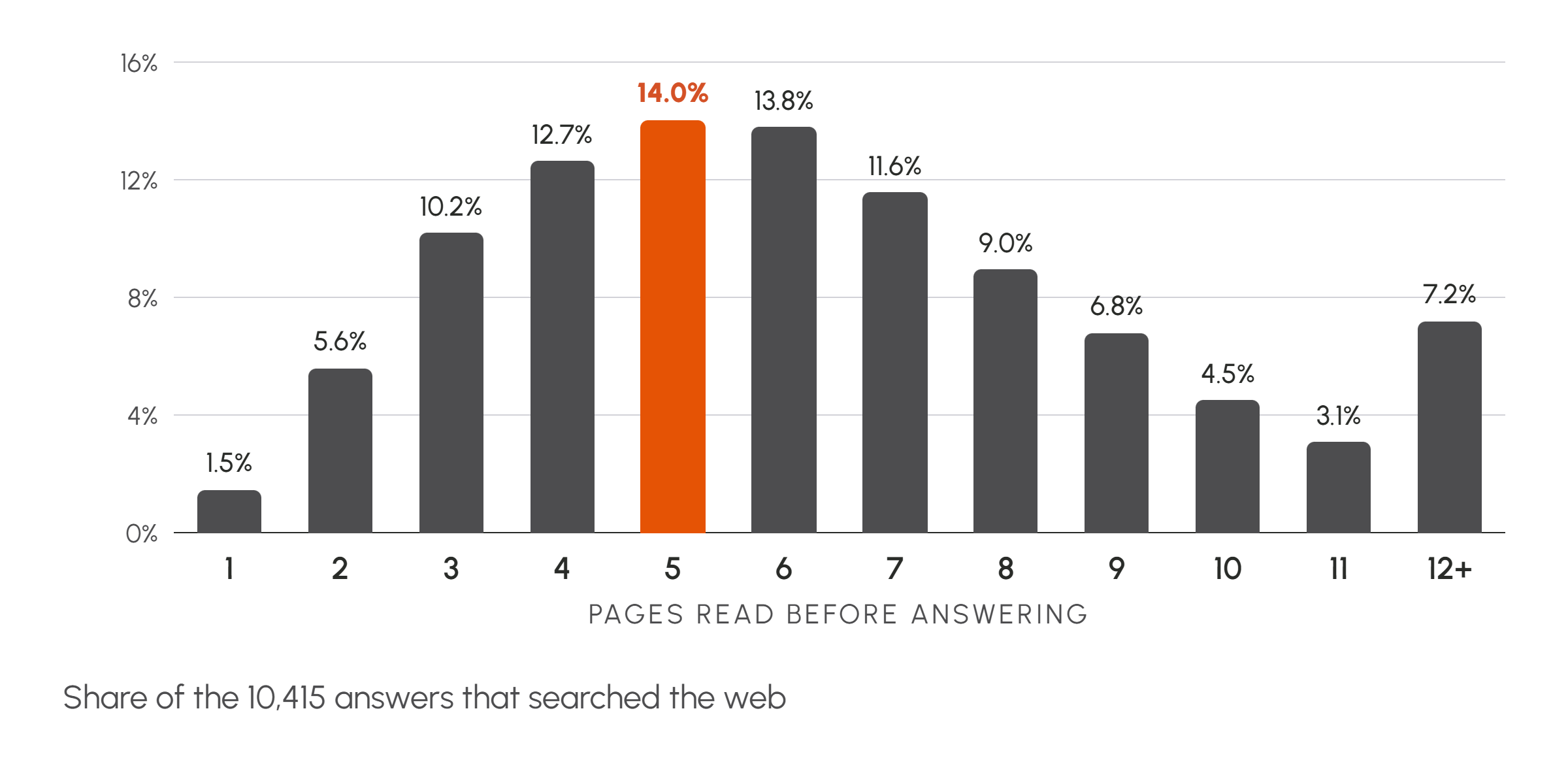
This doesn’t mean every ChatGPT answer is limited to three citations. But it does illustrate the competition for visibility within AI-generated answers.
Even if ChatGPT discovers your content, there’s no guarantee it will include a citation to your website.
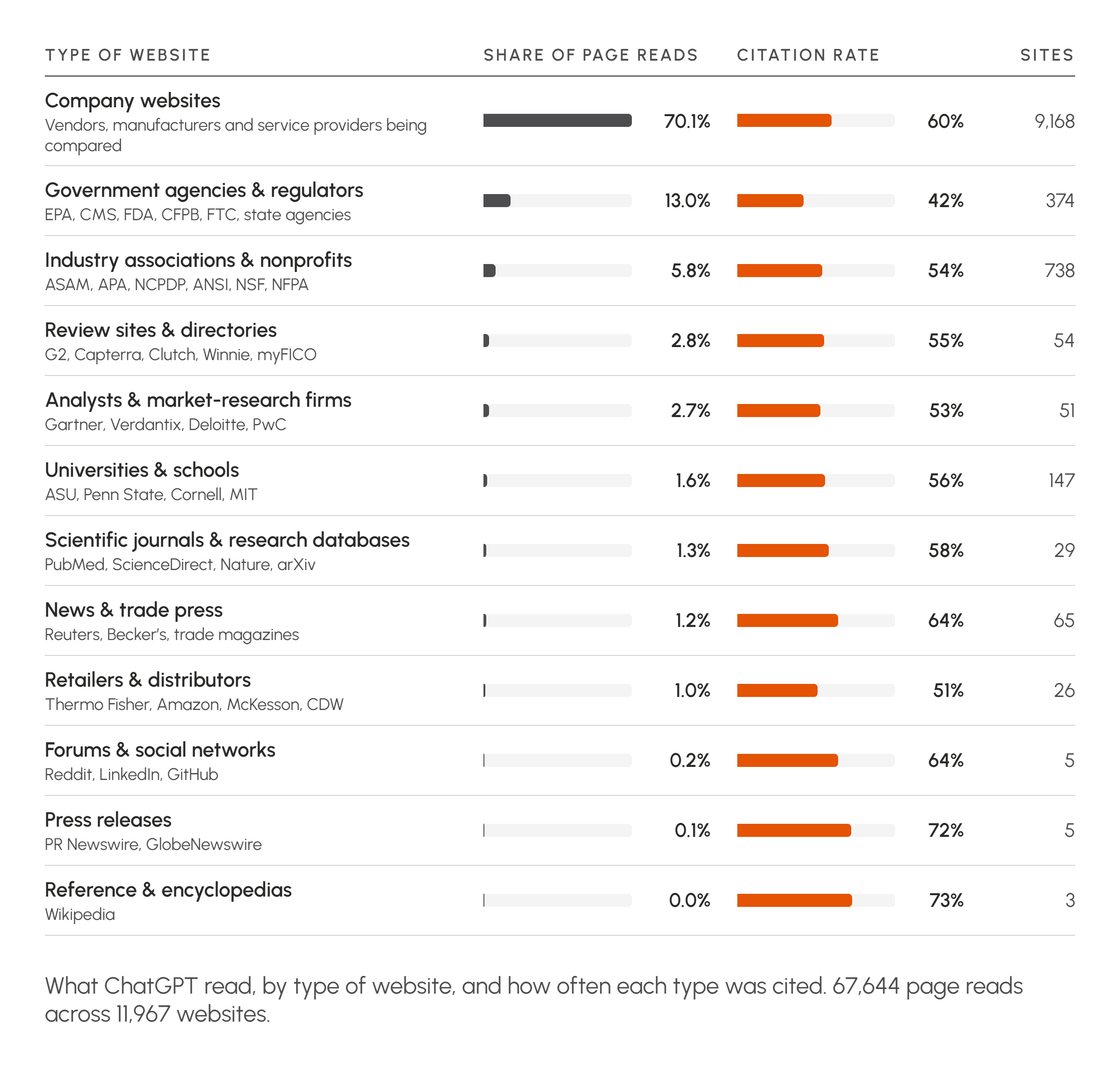
ChatGPT goes straight to the source more often than you might expect. 70% of the pages it read came from company websites, while government sites made up 13% and associations, review sites, and analysts each accounted for smaller shares.
Company websites were also cited 60% of the time, above the 57% average across all reads. Government sites, by comparison, were read often but cited just 42% of the time.
For businesses, that’s good news: your own website is very much in the running.
Not all pages have the same likelihood of earning a citation.
Our research found that pages focused on a specific product, service, or topic were more likely to be cited than homepages.
Homepages, meanwhile, accounted for 18% of reads, making them one of the most frequently accessed page types. However, they were cited only 52% of the time, the lowest rate among the page types we analyzed.
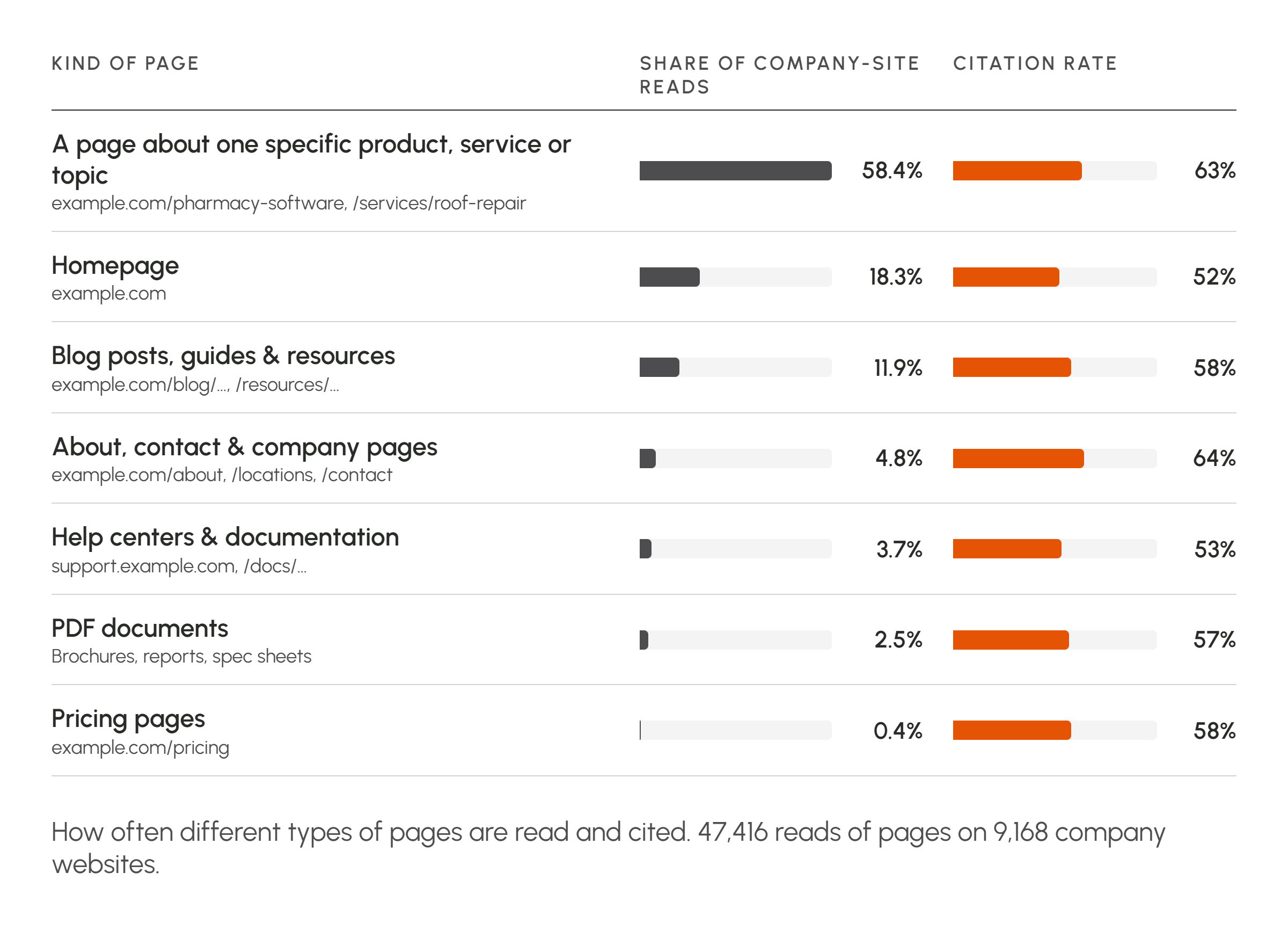
We also noticed a few other patterns:
For businesses, these findings reinforce the importance of creating pages that thoroughly address specific topics.
Rather than relying on a homepage to communicate everything about your business, consider whether your individual product and service pages provide complete, useful answers to the questions potential customers are asking.
Having multiple pages from your website appear in ChatGPT’s search activity doesn’t necessarily mean you’ll earn more citations.
In our study, ChatGPT typically cited about one page per website, even when it read multiple pages from that site.
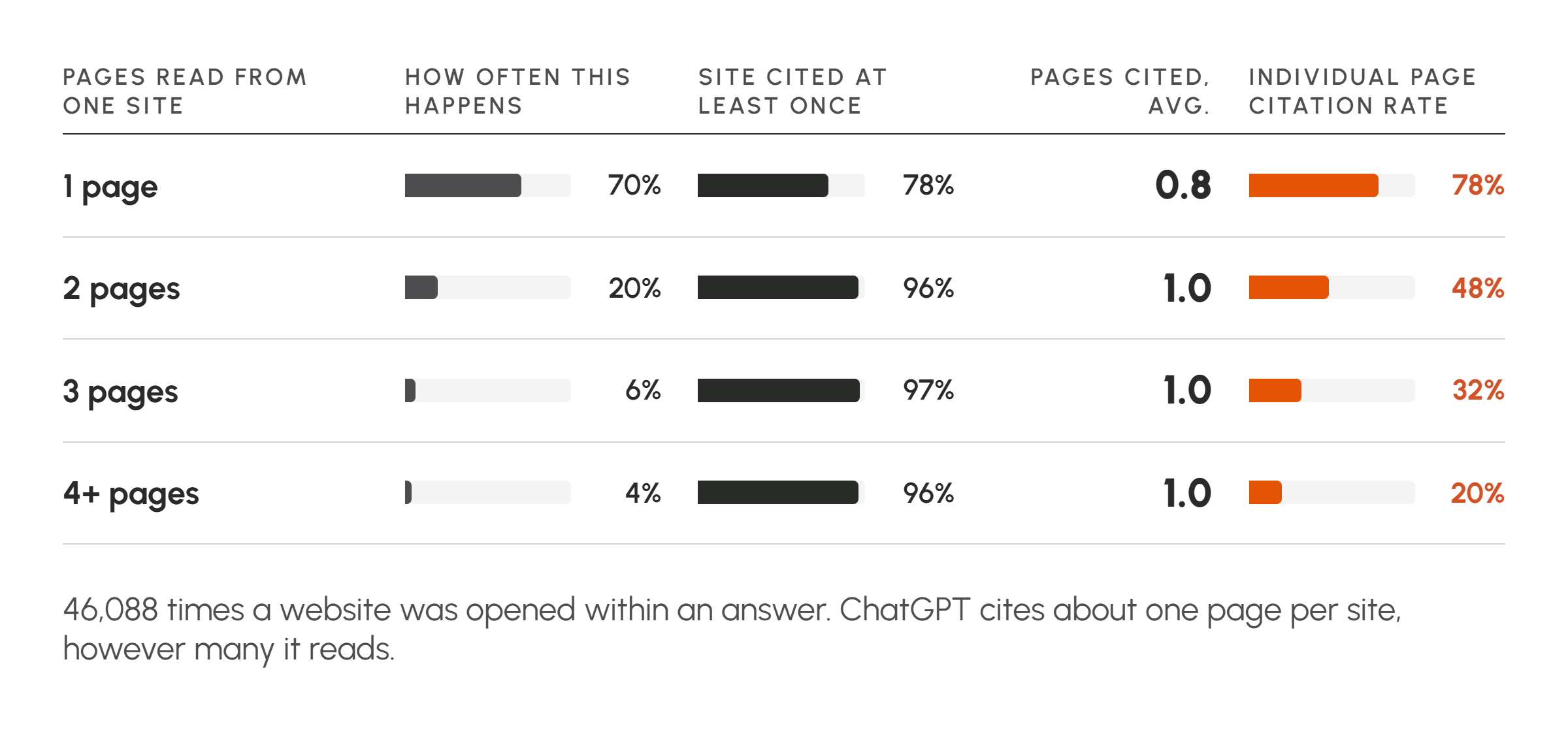
Across 11,212 answers, we recorded 46,088 instances of ChatGPT accessing a website, averaging approximately four websites per answer.
Here’s what we found:
This suggests that having more pages read from your website doesn’t necessarily translate into more citations.
Instead of spreading the answer to an important buyer question across multiple pages, consider building one comprehensive page that addresses it thoroughly.
Another pattern emerged when we looked at how often ChatGPT returned to the same pages throughout the study.
Pages that appeared more frequently in ChatGPT’s search activity were more likely to earn at least one citation.
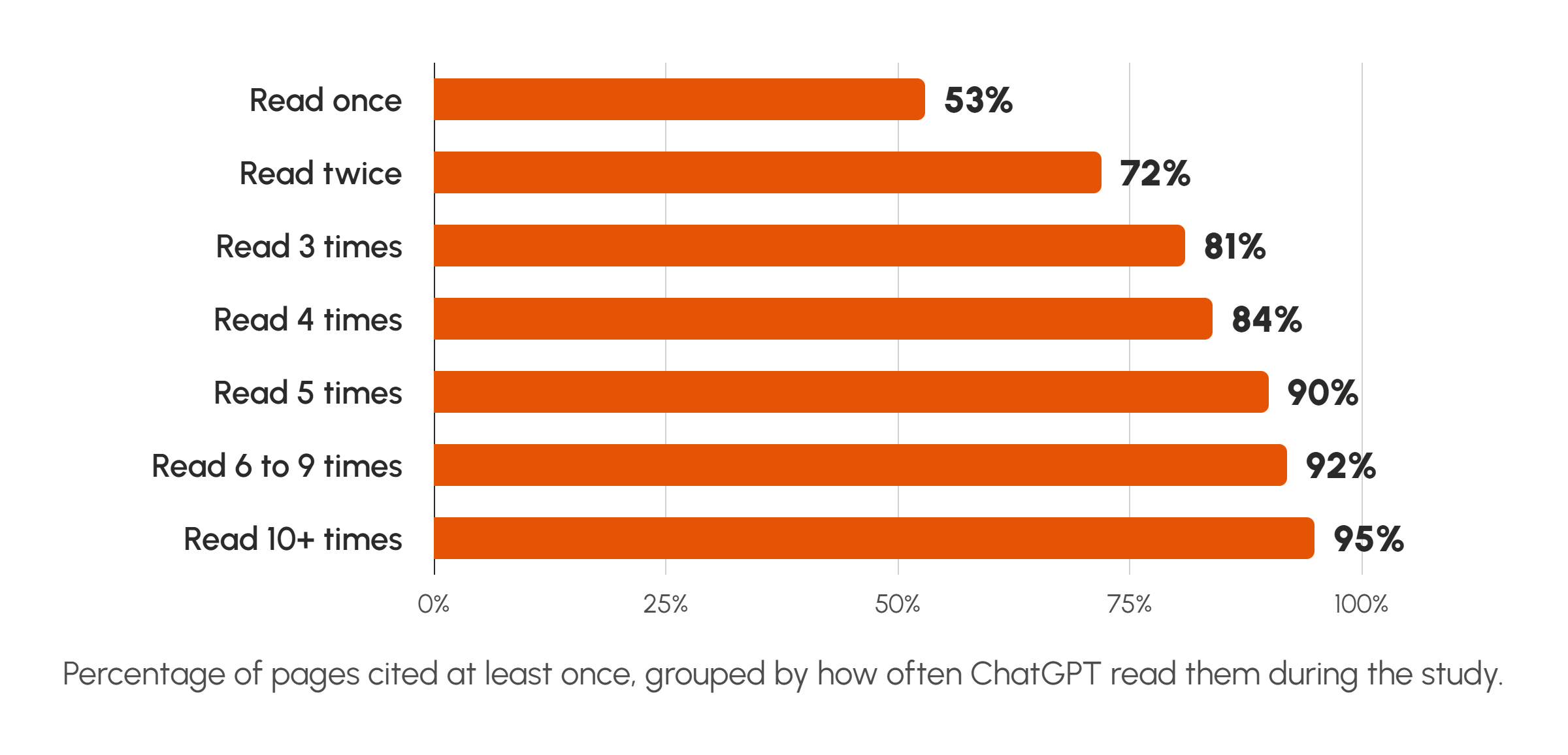
Among pages ChatGPT read only once, 53% were cited.
For pages ChatGPT read three times, that increased to 81%.
And among pages read ten or more times, 95% received at least one citation.
Of course, pages that are read more often have more opportunities to be cited. But these findings still highlight a useful distinction when evaluating AI visibility.
A page that ChatGPT reads frequently but never cites may deserve closer attention. It’s appearing in relevant searches, but it isn’t earning a place in the final answers.
Reviewing those pages could help identify opportunities to make the content more useful, specific, or relevant to the questions being asked.
Citation tracking tells you which pages ChatGPT credits, but not which pages it read and passed over.
That difference can help you distinguish between content that isn’t being discovered and content that’s being discovered but not cited.
Understanding both can help inform a more targeted GEO strategy, focusing on pages that have a better chance of being cited, given that they may already be read by LLMs
Our findings suggest that pages focused on a specific product, service, or topic are more likely to earn citations than general pages like homepages.
Think about the questions your potential customers are asking and whether your website provides clear, thorough answers. Depending on the question, that might mean improving an existing service page, creating a product comparison, publishing an educational blog post, or developing a dedicated resource.
The goal isn’t necessarily to create more pages. It’s to make sure your content addresses the questions that matter to your audience.
Homepages were among the most frequently read page types, but they had the lowest citation rate in our analysis.
Make sure your products, services, and locations have dedicated pages that provide enough information to stand on their own.
Pages that were read more frequently were also more likely to receive at least one citation.
If ChatGPT repeatedly accesses one of your pages without citing it, that may be an opportunity to review and improve the content.
Repeated reads don’t guarantee citations, but they can offer useful insight into which pages ChatGPT is already discovering.
One limitation of this type of analysis is that not every AI platform provides the same visibility into its search activity.
Gemini and Copilot display the sources they cite, but they don’t provide the same view of pages searched and passed over. That means we couldn’t measure the read-but-not-cited gap for those platforms in the same way.
However, we could compare their citation behavior across the same questions and time period.
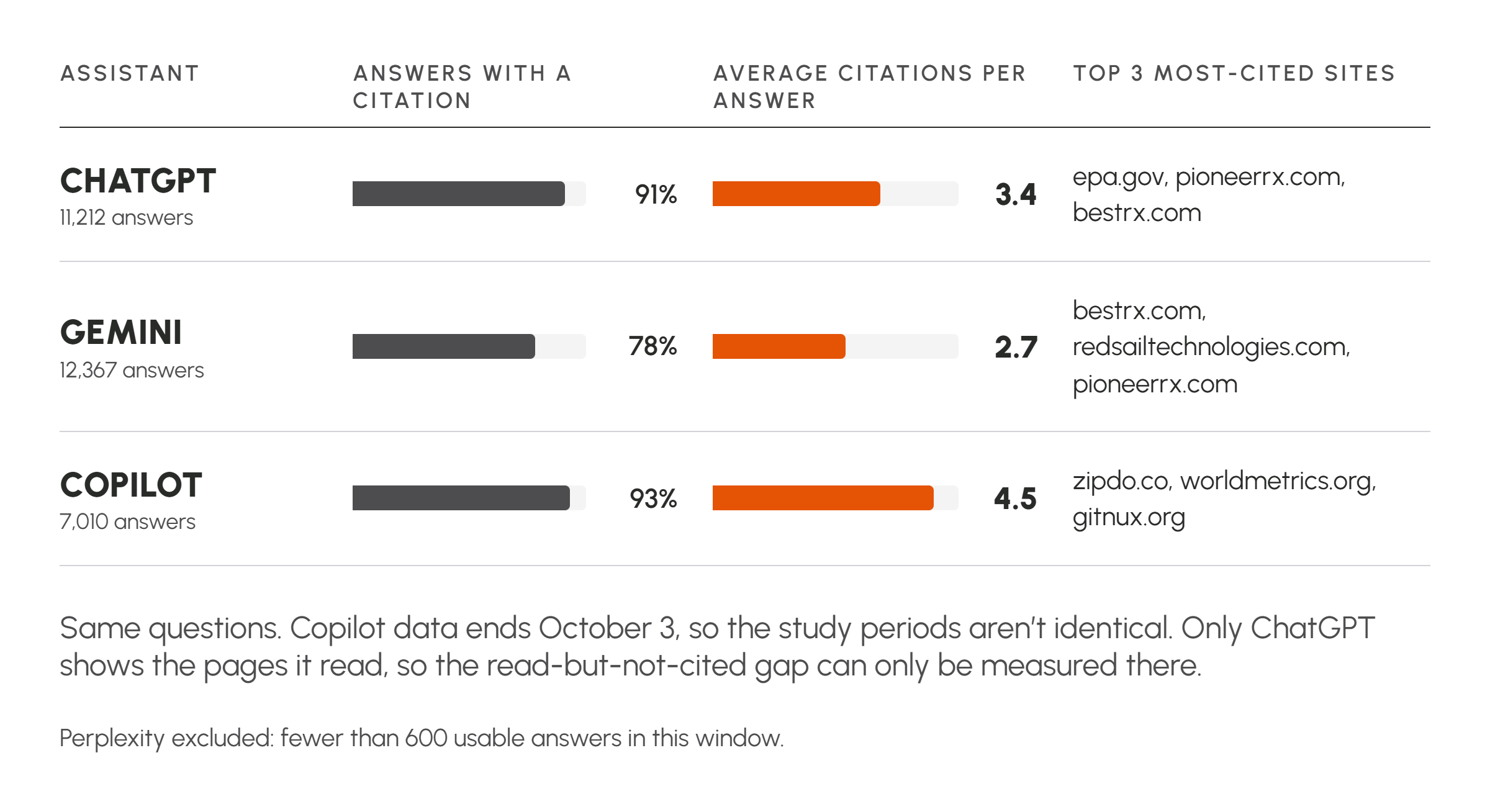
Copilot cited more sources per answer than the other assistants, and its most frequently cited sources tended to be statistics aggregation websites rather than company pages.
Gemini cited the fewest sources per answer and was the only platform among the three to include Reddit among its five most-cited websites.
These differences reinforce that citation behavior varies across AI platforms, and findings from ChatGPT shouldn’t automatically be assumed to apply to every AI assistant.
Getting your content discovered by ChatGPT and getting it cited are two different challenges. With 43% of page reads resulting in no citation, understanding where your content appears in the AI search process is just as important as measuring whether it earns a mention in the final answer.
At Perrill, we help businesses uncover those opportunities through our GEO services and PAVE, our AI visibility intelligence engine. By measuring how your brand appears in AI-generated answers, we can help you identify gaps, prioritize improvements, and build a GEO strategy informed by real data.
Ready to understand and improve your AI visibility? Explore our GEO services or try PAVE free for 30 days.
The dataset also focuses on B2B questions, so sources that may be more influential in consumer searches, such as retail websites, review platforms, and forums, are likely underrepresented.
Finally, our page classifications are based on URL structures, which means some pages may have been categorized incorrectly if their URLs didn’t clearly reflect their content.